
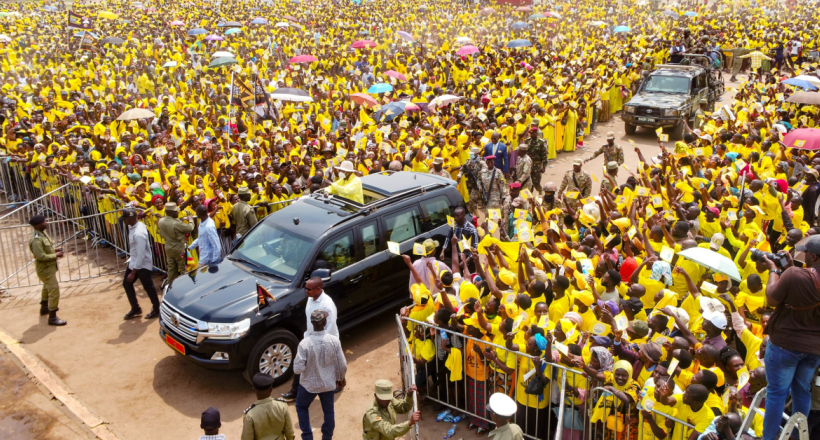
Kasese — President Yoweri Museveni has pledged major transport infrastructure projects for Kasese District, including a new airport and a Standard Gauge Railway (SGR) line, as part of his broader plan to boost tourism, trade, and connectivity in the Rwenzori region.
Speaking to residents during a campaign rally on Thursday, the NRM presidential flagbearer said upgrading Kasese’s transport network is a priority, given the district’s strategic location and tourism potential.
“We are going to renovate the railway line. Work has already begun on the Malaba–Kampala section, and later we shall extend services to this region. Here in Kasese, we shall build a new SGR,” Museveni who started his campaign tour of the Rwenzori sub-region said.
He added that an airport is also planned for the district. “We shall construct the airport here because of tourism activities in the area. We had to first build the one in Hoima because of oil.”
Kasese already has an airstrip while the old railway line was dilapidated and is now non-functional.
Museveni told the crowd that improved transport infrastructure would significantly boost economic activity in Kasese by easing the movement of people and goods, expanding market access, and supporting investment.
The President also reminded residents of the progress already made in road construction. The Fort Portal–Kasese road has been upgraded twice, as have the routes to Katunguru and Bushenyi–Ishaka. He said the Kikorongo–Bwera road, which had deteriorated, will be worked on again, and the Fort Portal–Bundibugyo road remains a key connection for the mountainous areas.
Beyond transport, Museveni said Kasese has benefited from expanded social services, including 260 government primary schools, 25 secondary schools, a district hospital, and several Health Centre IIs and IIIs. He pledged that more schools would be added.
He also addressed wealth creation, emphasizing that infrastructure alone does not guarantee prosperity. “Tarmac roads can pass through your area, but that doesn’t mean you will become rich,” he said. He encouraged residents to adopt the four-acre model—coffee, food crops, pasture, and livestock—to improve household income.
Museveni credited government programmes such as Operation Wealth Creation and the Parish Development Model for reducing subsistence farming, saying 70% of Ugandans now work for both food and income, compared to 32% when OWC began.
On job creation, the President reiterated that most employment in Uganda must come from private enterprise. “Government provides only 480,000 jobs for 50 million people. Government jobs are consumptive; jobs are created by individuals and companies.”
Museveni concluded by urging residents to protect the peace that allows such development programs to flourish, warning that any attempts to destabilize the country will be firmly resisted.